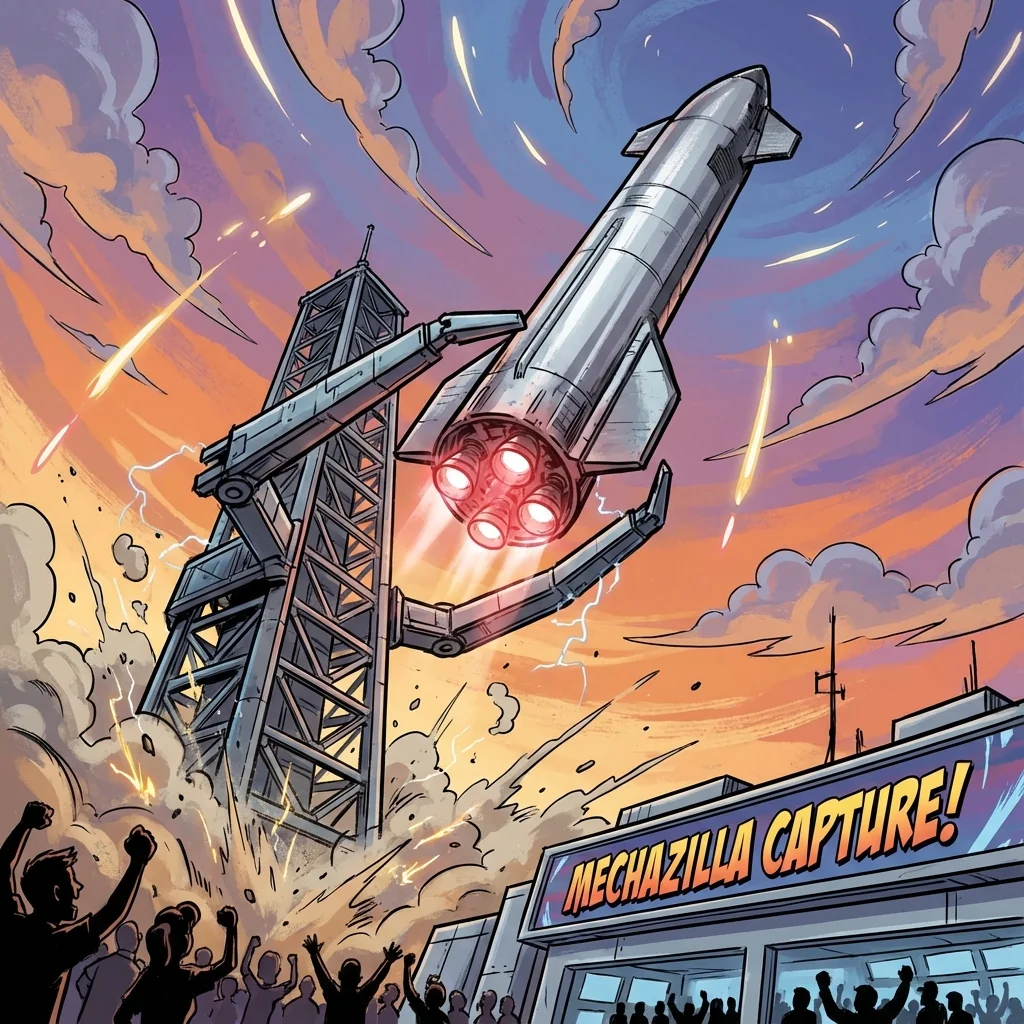
On October 13, 2024, SpaceX caught a returning Super Heavy booster with the arms of its launch tower at Starbase. The maneuver was a first for the Starship test program and demonstrated a recovery method designed around returning the booster to its launch site. SpaceX’s official Flight 5 recording and account show the sequence.
What happened during the flight
After ascent and stage separation, Super Heavy completed a boostback maneuver, descended, and used a landing burn to slow for the tower catch. The Starship upper stage continued separately, reentered the atmosphere and splashed down in the Indian Ocean. The upper stage’s descent and flip should not be confused with the booster’s return.
SpaceX reported that thousands of vehicle and ground-system criteria had to be satisfied before committing to the catch attempt. Bringing a large booster into a narrow capture area requires the vehicle and tower to function as one coordinated recovery system.
Why catch it at the tower?
The approach moves the capture hardware to the ground and could simplify some steps between recovery and a later flight. That makes turnaround an important engineering question: how much inspection, repair and preparation will a recovered vehicle actually require?
What one catch cannot establish
Flight 5 demonstrated a successful catch, not a complete cycle of routine, rapid reuse. A claim about multiple launches per day would need repeated operational evidence. Costs also depend on vehicle lifetime, refurbishment, ground infrastructure and launch cadence. The event was a concrete recovery milestone; it did not, by itself, prove the economics of a Mars settlement.
Sources reviewed September 24, 2026. This is a retrospective on Flight 5, not a statement about the latest Starship flight.