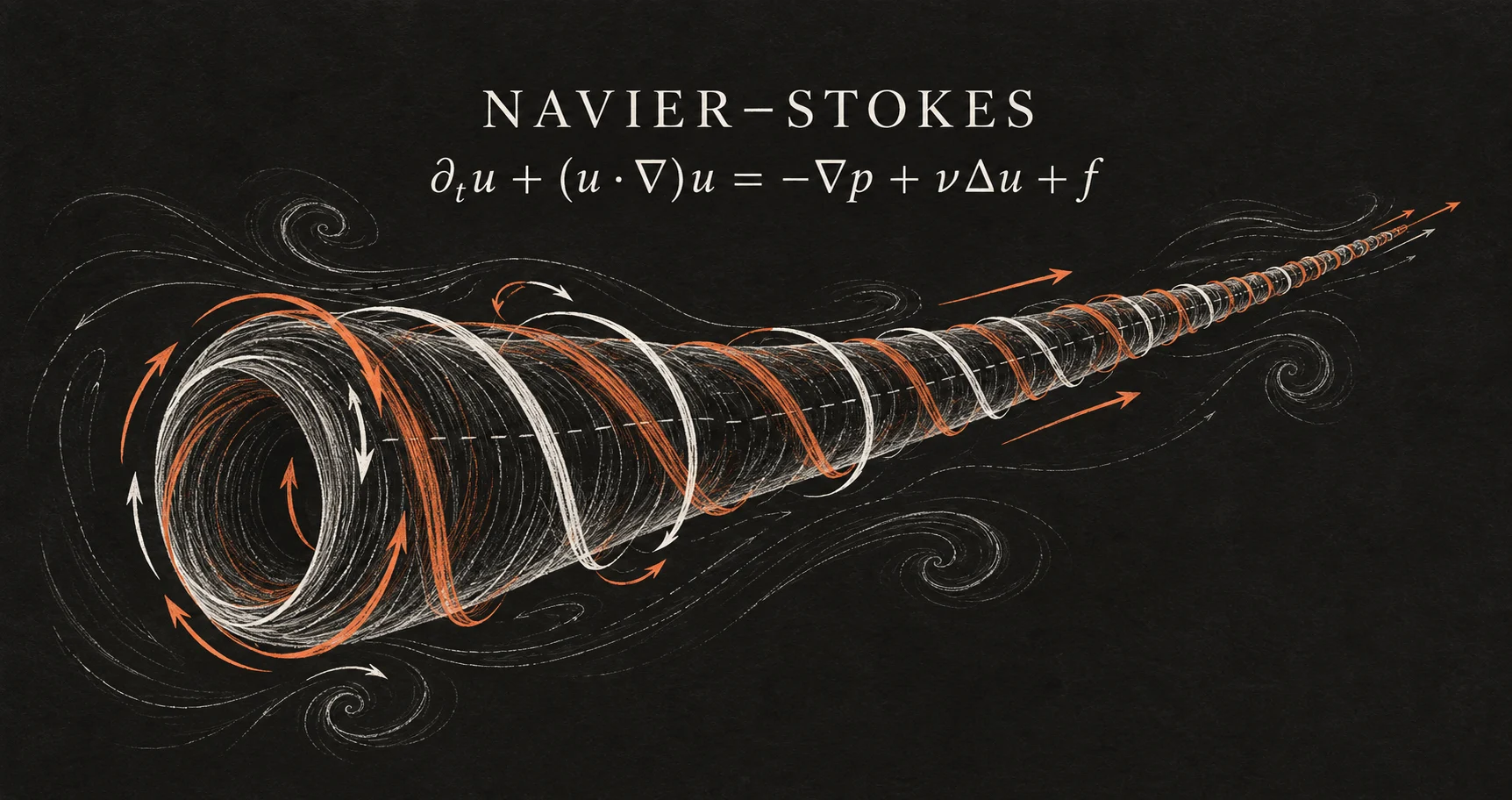
Can smooth fluid motion develop a mathematical singularity? On September 8, 2026, OpenAI announced a proof that certain three-dimensional incompressible Navier–Stokes flows can develop unbounded velocity in finite time. The construction includes a smooth external force. Clay’s September 11 response acknowledged an apparent resolution while emphasizing its evaluation process.
What the construction describes
Viscosity tends to smooth differences in a fluid’s velocity, while nonlinear motion can intensify them. According to the announcement and accompanying manuscript, fluid starting at rest develops a contracting, stretching vortex under smooth forcing. Velocity grows without bound in a shrinking region while total kinetic energy remains finite. A singularity here concerns the equations’ continuum model; it is not a prediction that ordinary water physically reaches infinite speed.
The scope of the claim
The authors say the result establishes alternatives C and D in the official Millennium problem statement. These alternatives permit suitable smooth forcing. The announcement therefore does not settle global regularity for unforced three-dimensional Navier–Stokes flow. That distinction matters even though the prize formulation allows establishing one of its alternatives.
What review still means
A manuscript and Lean formalizations give mathematicians material to examine. Clay’s response is not a prize award: its rules require qualifying publication, at least two years and general acceptance before consideration. Understanding the mechanism, checking the assumptions and evaluating the result’s reach remain distinct from announcing it.
Sources reviewed September 24, 2026. We have not independently checked the analytical proof or run its formal verification.