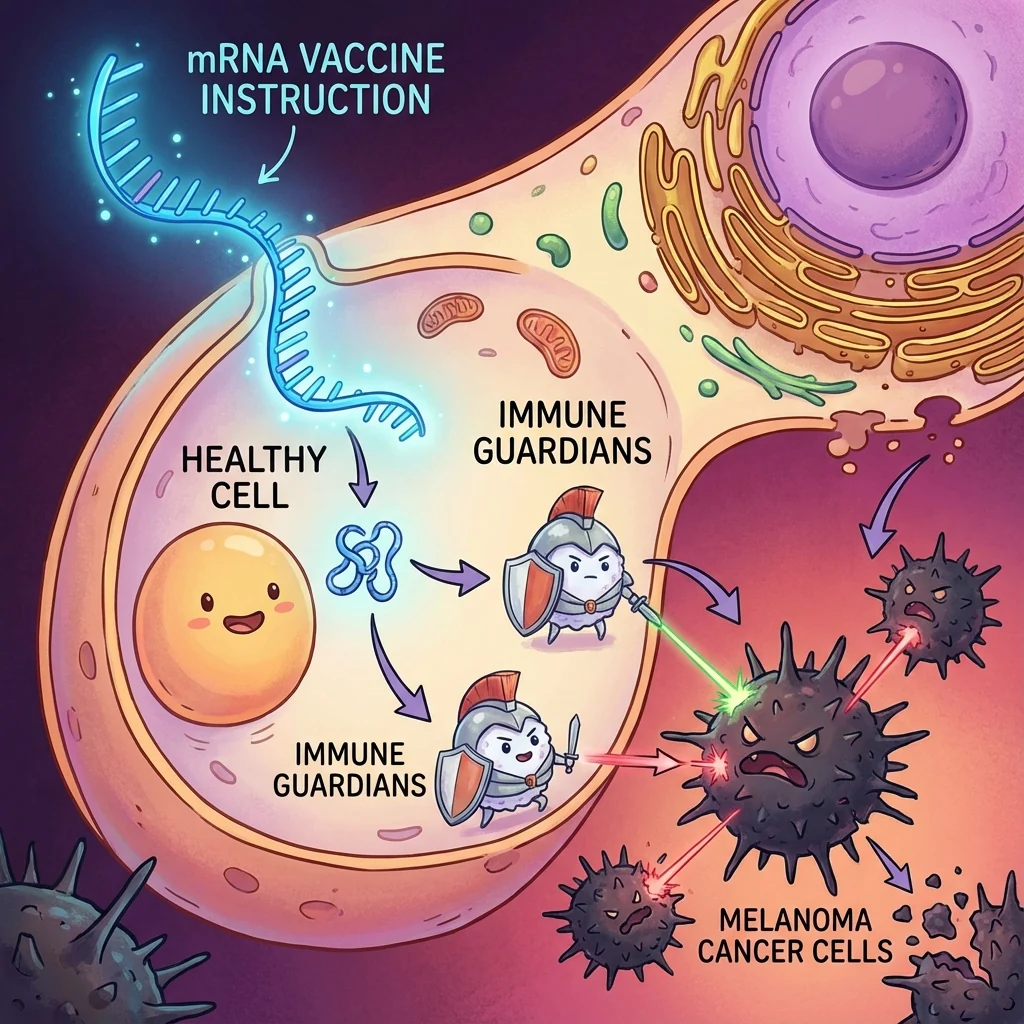
A personalized cancer vaccine aims to help the immune system recognize features of a patient’s own tumor. In results announced on June 3, 2024, Moderna and Merck reported that mRNA-4157, also called V940, improved a melanoma trial’s recurrence-free survival outcome when added to pembrolizumab, the immunotherapy sold as Keytruda.
What the 49% figure means
The randomized Phase 2b study enrolled 157 patients with high-risk stage IIIB–IV melanoma after complete surgical removal. At a median follow-up of 34.9 months, the combination’s hazard ratio for recurrence or death was 0.51 compared with pembrolizumab alone: a 49% relative reduction in that hazard. This is not a 49-percentage-point improvement or a guarantee for an individual patient. The reported 2.5-year recurrence-free survival estimates were 74.8% and 55.6%, respectively.
A therapy tailored to the tumor
The mRNA encodes up to 34 selected tumor-associated neoantigens, aiming to train a targeted immune response. The trial tested the vaccine with immunotherapy after surgery. It did not show that vaccines replace chemotherapy across cancers, and side effects and patient selection remain part of the clinical assessment.
What has changed since 2024
On August 19, 2026, the companies announced positive topline Phase 3 results for intismeran autogene, the therapy’s newer name, in resected stage IIB–IV melanoma. That release described it as investigational and said detailed data would be presented later and shared with regulators. Trial progress is encouraging, but an announcement is not regulatory approval or evidence of a universal cancer cure.
Updated September 24, 2026. A research summary, not treatment advice; discuss treatment choices with your oncology team.