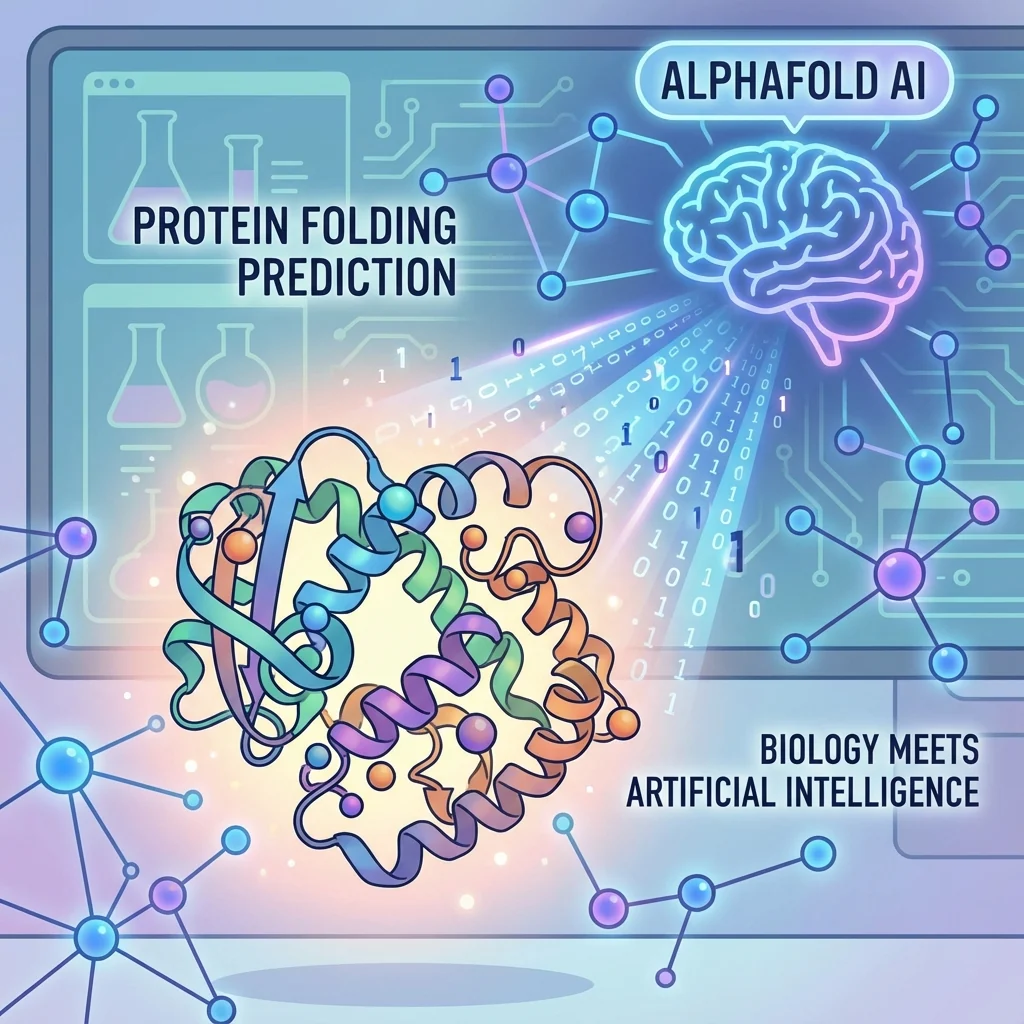
Understanding a protein often means understanding what it interacts with. On May 8, 2024, Google DeepMind and Isomorphic Labs introduced AlphaFold 3, a model that predicts three-dimensional structures of molecular complexes involving proteins, DNA, RNA and other molecules. The original research paper reported improved performance across several interaction benchmarks.
How a structure takes shape
The system uses a diffusion model to refine noisy atomic coordinates into a predicted arrangement. As the launch explanation describes, the broader range of supported molecules lets researchers investigate combinations that matter to cellular processes and drug discovery.
A plausible structure can suggest where a molecule contacts a protein or which part of a complex deserves closer study. Those hypotheses can help researchers choose and interpret laboratory experiments.
Structure is one part of the answer
A predicted binding pose does not by itself measure binding strength, prove a drug is safe or show that it treats a disease. Nor is a single predicted structure a movie of the molecule’s behavior. The authors describe limitations involving molecular motion, incorrect chemistry, overlapping atoms and invented order in disordered regions. EMBL-EBI’s training guide explains why confidence and target-specific checks matter.
A better starting point for experiments
The useful advance is access to more informative structural hypotheses across different types of molecules. Turning one into a medicine still requires experimental testing and clinical development. AlphaFold 3 can help ask sharper biological questions; its launch did not establish automatic screening of billions of drugs or guaranteed cures.
Sources reviewed September 24, 2026. This article describes the 2024 model and its documented limitations.